 Written by Helena Markou
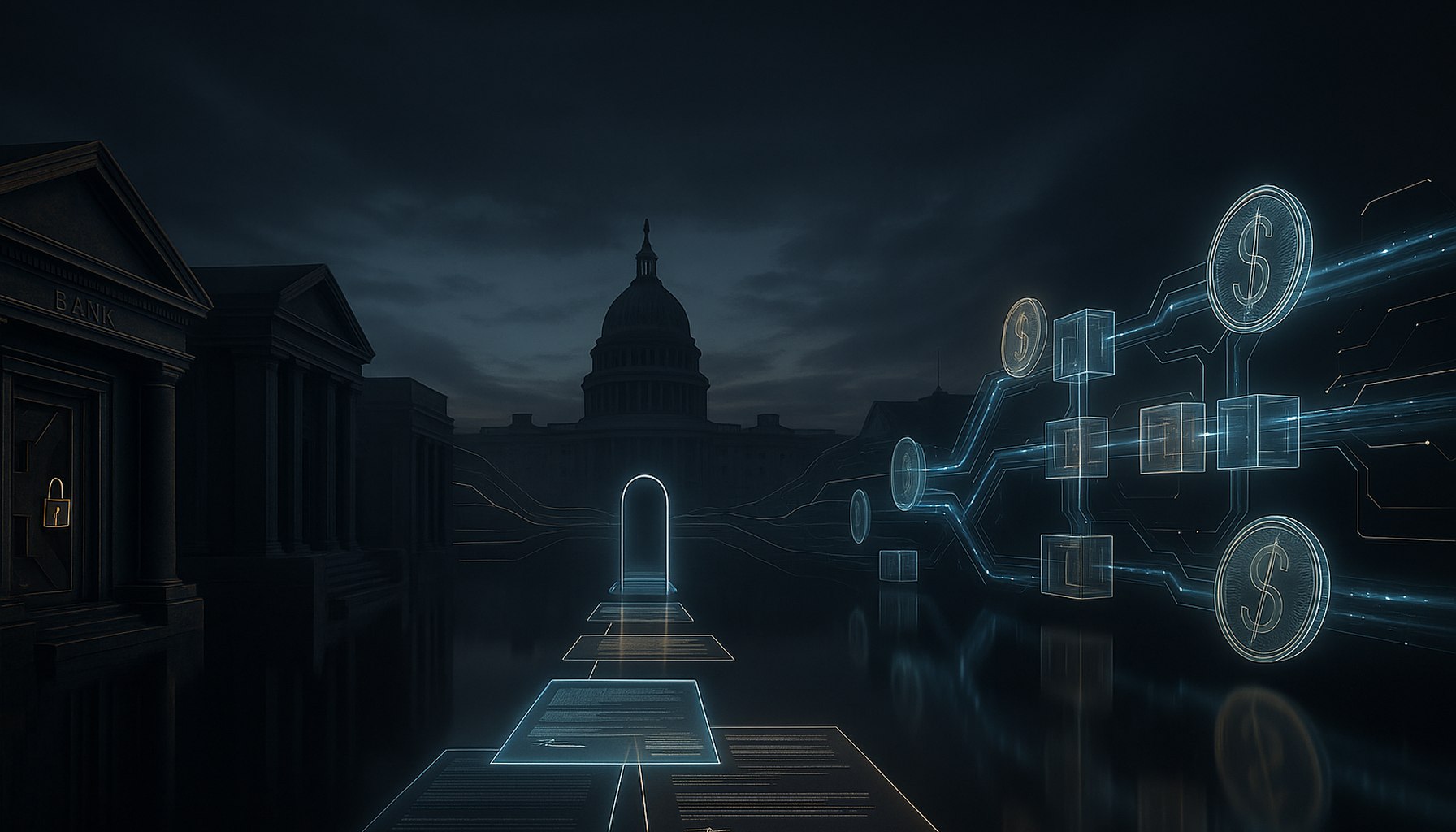
The most important crypto development of the last forty-eight hours is not a token launch, a Layer 2 rollout, or another burst of treasury speculation. It is the emerging architecture around identity. A new Paul Hastings analysis of the proposed customer-identification-program rule for permitted payment stablecoin issuers makes clear that U.S. regulators are drawing the first serious operational line around where stablecoins become bank-like and where the broader on-chain market is still allowed to remain something else.
That distinction may end up mattering more than any single yield opportunity or payments partnership. For years, the crypto industry has argued that stablecoins are both financial infrastructure and open internet-native instruments. Regulators have now started to answer the harder question: if stablecoins are going to plug into the formal dollar system, who exactly has to know whom, and at which point in the transaction chain?
The analysis summarizes a proposed rule jointly issued by FinCEN, the Federal Reserve, the FDIC, the NCUA, and the OCC under the GENIUS Act. The key operational requirement is familiar enough: a risk-based customer-identification program that collects name, address, date of birth or formation, and identifying number before an account is opened. The more revealing feature is the boundary condition. As described in the proposal, the obligation appears to attach to customers with formal account-holding relationships with the issuer, not necessarily to every downstream wallet holder who touches a token in the secondary market.
That is a profound design choice. It implies that Washington may be converging on a two-zone stablecoin model.
| Zone | Likely treatment |
| Issuance and redemption edge | Bank-like compliance, direct customer identification, formal onboarding |
| Secondary-market token circulation | More room for intermediaries, exchanges, and smart-contract activity without issuer-level KYC on every holder |
This is why the proposal deserves attention far beyond legal specialists. A stablecoin issuer forced to identify every secondary-market user globally would face an almost impossible operating burden and would risk breaking the very composability that made dollar tokens so useful in the first place. The Paul Hastings analysis notes that the proposal itself recognizes the danger of turning the rule into a sweeping obligation to collect and verify the identity of every downstream participant. That acknowledgement is the real signal. Regulators are not merely imposing compliance. They are trying to decide how much crypto architecture can survive contact with the banking perimeter.
There is a second-order implication here for DeFi. If the issuer’s CIP duties mainly attach to direct mint and redeem relationships, then the industry will have a strong incentive to deepen an intermediated model in which institutions, exchanges, and other gateway entities sit between issuers and end users. That may preserve much of the secondary market’s flexibility, but it also concentrates power in the entities that control the fiat on-ramps and redemption channels. In other words, the token may still travel openly, but the critical chokepoints become more legible, more licensed, and more bank-like.
Michael Barr’s statement adds another important wrinkle. He warns that the framework may not yet do enough about illicit-finance risks in secondary-market activity and signals that regulators will review comments on whether the rule should reach further. That means the line is not settled. The current proposal is best understood as a draft map of the perimeter, not the final border.
For crypto markets, the big takeaway is that stablecoins are no longer being regulated as a loose species of digital asset. They are being redesigned, in law and compliance logic, as a quasi-banking layer with selective openness. The likely outcome is not the full domestication of on-chain dollars, nor the preservation of the old free-form model. It is a hybrid structure: strict identity and sanctions discipline at the issuance core, with a negotiated tolerance for token mobility once assets move into broader circulation.
That may sound technical, but it is probably the most economically significant path available. Stablecoins only become systemically large if they can be trusted by institutions and still remain operationally useful for global settlement, exchanges, and applications. The proposal is an attempt to force that compromise into a rulebook.
Crypto spent years claiming that code could replace intermediaries. The stablecoin market is heading toward a more realistic synthesis. Code will still move value. But the dollar edge of the system is being rebuilt so that identifiable institutions, not anonymous flows, carry the legal burden. The next phase of stablecoin growth will depend on whether that perimeter is narrow enough to preserve utility and firm enough to satisfy the state.